


Typhoid Mary and the Public Health Dilemma of Living Carriers.

Updated: Mar 1
On November 11, 1938, Mary Mallon, the woman known to the papers and to all of history ever after as Typhoid Mary, passed away on North Brother Island, where she had been lodged by the New York City Department of Health for the previous 23 years to safeguard the general population from the disease which she carried. Her life’s course since 1907 had been entirely determined by the persistence in her body of an illness that, to her dying day, she insisted she never had, but which she regularly passed to the individuals whose food she prepared in her profession as a cook.
She was the first individual identified by modern bacteriological science as a “living carrier” of the typhoid bacillus - an individual entirely healthy to all appearances, but able to transmit the disease she carried to others under the right conditions. Her existence called forth new questions for those engaged in the emerging field of public health - how many more like Mary are there? How do we find them before they cause harm? And once found, how do we ethically and responsibly protect civilization from potential epidemics while also safeguarding the freedom of individuals?
The story of Mary Mallon (1869-1938) is the story of public health finding its first answers to these questions, making up the rules as it went along in this new and often frightening world, as much as it is the story of an immigrant trying to make sense of everything happening to her while attempting to craft for herself something like a life worth living. She was born in 1869 in Ireland and came to the United States in 1883, just in time for the great foodie craze of the late 19th century, as wealthy households competed with each other to put the finest European cuisine before their guests. Mary, by all accounts, was a gifted cook in an age that valued them, and this skill allowed her to escape the routine grind that was most Irish immigrants’ lot.

By the early 20th century, she was regularly cooking for upper class families, who routinely spoke of their satisfaction with her work. Sometime on or about 1900 she contracted typhoid fever, a disease that regularly killed some ten percent of those who came down with it, but which struck the robust Mary as little more than a flu, easily overcome. Like a tenth of those who had typhoid fever, the bacillus remained in her system, an outcome that she could have gone her entire life without being aware of it were it not for her profession. As a cook, and particularly as a cook of items like puddings and ice creams that were not placed in an oven and raised to a bacteria-killing temperature, she was uniquely suited to pass germs from unclean hands onto the food she served, and for a seven year period from 1900 to 1907 typhoid followed her wherever she went.
Of the eight families she was documented to have worked for in this era, seven of them displayed cases of typhoid soon after she joined the household, but each time the incidents were either not investigated, or were written off as due to water contamination or blamed on the first person to show symptoms. The idea of living carriers had been existent in the medical literature, and particularly that of Germany, for a decade by that point, but nobody connected the dots on Mary’s role until a homeowner by the name of George Thompson, eager to clear the reputation of a rental property where six members of a family had caught typhoid, hired an epidemic expert by the name of George Soper (1870-1948).
Soper was meticulous in his investigation, eliminating water and food contamination as the sources of the disease, and moving on to a detailed documentation of the individuals who had come into contact with the family. When he was told that Mary had been a new addition to the family just before the outbreak, he dug into the records of Mary’s hiring agency, and found a trail of typhoid occurrences stretching back seven years, encompassing some twenty-two cases and at least one death, all happening soon after Mary’s arrival with the families in question. Placing this chain of incidents together with his own knowledge of the German theory of living carriers, he hypothesized that Mary was, through her handling of food, spreading typhoid wherever she worked, but needed to run blood, feces, and urine tests to be sure.

His approach was not great. He first contacted Mary at her work, informed her of his theory, and asked her to give up samples of her precious bodily fluids. Faced with a strange man claiming that she was spreading a disease she believed she never had, and asking her earnestly for samples of her excrement, she logically enough became angry and brandished a carving fork at him to clear him from the premises. He tried again, at her home, carting along a doctor friend whom he apparently thought would help to lend validity to his ideas and diffuse the situation, but that attempt failed equally spectacularly and there was nothing for it but to bring in the long arm of the New York City Health Department, which by city statute had virtual carte blanche to act how it saw fit in cases of potential danger to the public health.
They sent out Josephine Baker (whom we met earlier in this series as the reigning brain behind the country’s child health care movement of the early 20th century), then just at the beginning of her career, thinking that a woman bringing the request might produce a better result. It did not, and Baker had to return the next day with five policemen. Mary slammed the door on them and, when the police entered the room, they found it completely empty. Seeing the window open and a chair perched near the fence beyond, they reasoned that she had gone on the lam, and only found her at last hiding in a garden shed because of a patch of calico fabric from her dress that was peeking from the doorway.
It took the full might of all the assembled policemen to subdue her, while Baker later wrote that on the drive to Willard Parker Hospital that ensued she had to physically sit on Mallon to keep her from leaping up and trying to break free. Once at the hospital, bacteriological tests revealed substantial presence of typhoid bacilli in her system, proving Soper’s theory and providing the world with its first example of a living typhoid carrier, prompting the significant question of What Now?

Ideally, Mallon would have been cured of her carrier status so that she could rejoin the world in her chosen occupation, but at the time nobody knew how that could be done. Various medications were tried, but none seemed to have a reliable impact on the bacillus count in her fecal samples. It was believed that the gallbladder was the preferred residence and breeding ground for typhoid bacilli, and that its removal might cure her, but Mallon rejected that option, and when gallbladder removal in later cases involving living carriers didn't seem to impact bacillus count, it reenforced this decision.
There seemed to be nothing to do but hold her in isolation for an unspecified amount of time, a strategy that nobody liked, but that nobody could offer a better alternative to. Meanwhile, word got out that a poor Irish cook was being held against her will in a purgatory like state of isolation, never having had the benefit of a trial or appeal, and well-wishers soon provided funds to secure her legal counsel (a popular theory is that William Randolph Hearst fronted the money as part of his drive to secure sensational copy for his paper in its constant battle with Pulitzer’s World).
Mallon turned out to be something of a deft hand in the public relations department, tugging on heartstrings with the injustice of her situation, detained indefinitely for something she had no control over, prodded by doctors whose story about how best to treat her kept changing, all in the name of a disease that she adamantly denied ever having. Unfortunately for her, the hospital’s stool samples told a compelling story that, though the typhoid bacillus was intermittent in her labwork, the results were nonetheless positive over two-thirds of the time, and the judge, unwilling to have any future outbreaks of the disease caused by her release be upon his head, denied her request to be set at liberty.
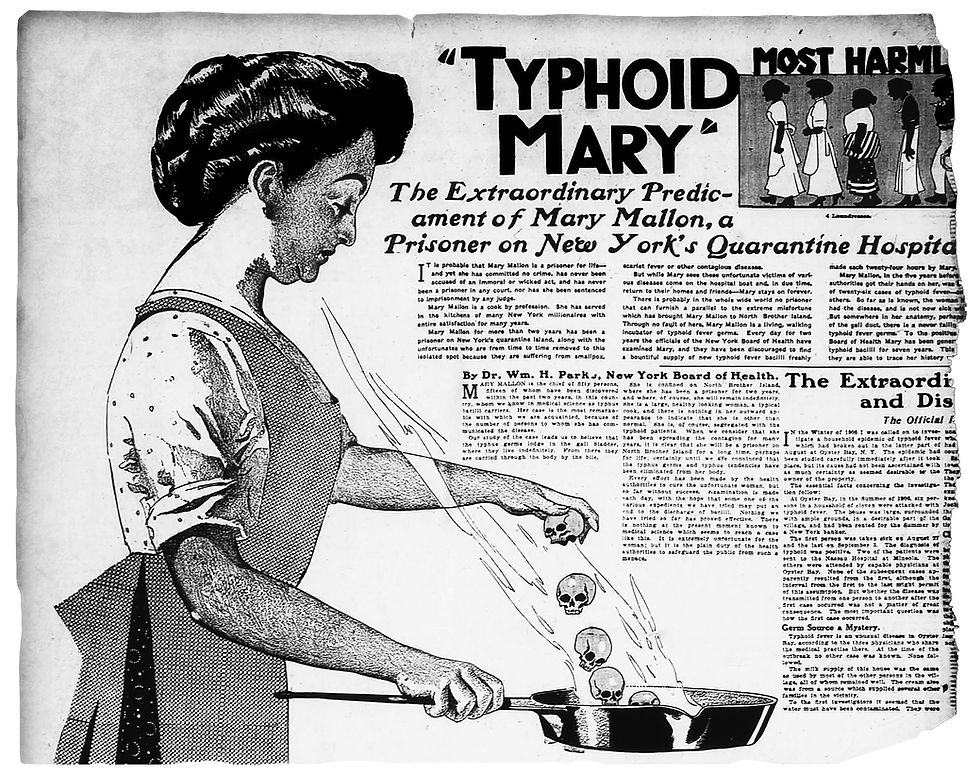
Though denied by the courts, Mallon’s story proved affecting enough that the next health commissioner, Ernst Lederle, took pity on her position in 1910 and released her after she promised to never work in food preparation again. She was set up with a position as a laundress and given her freedom. She was not long in breaking her promise, for a host of potential reasons that historians love to speculate about - perhaps the step down in status from honored cook to anonymous washwoman was too much for her pride to take, perhaps the reduction in salary was too much to bear, perhaps she simply missed doing the one thing that she persistently excelled at - whatever the reason, she was soon back in the kitchen again. Not for upper class families, of course - they tended to hire from reputable agencies, and those agencies knew Mallon too well to take her on as a client - but for families and organizations that needed an extra kitchen hand and didn’t look too closely at who was offering it.
For five years, Mallon kept successfully under the radar until she made the decision to take up employment at Sloane Maternity Hospital under the not at all clearly fake name of Mary Brown. This was evidently a terrible, bordering on criminal, decision, as it meant exposing pregnant women and newborns to typhoid fever, and in early 1915 an outbreak at the hospital resulted in 25 cases and 2 deaths. Mary, to her credit, did not run this time when her role was found out. She did not threaten the authorities, scale fences, secret herself away in a shed, or require the physical restraint of several strapping young men to drag her into custody, but was simply taken in her restroom without a fight.
The public was not so kind to Mallon’s plight this time around. The double punch of having gone back on her word and having done so in a manner that put mothers and babies at risk burned much of the good will she had earned through her first isolation period, and few were the voices seriously calling for her to be put back at liberty. And so she would spend the next twenty-three years of her life on North Brother Island. This did give her food, shelter, and medical services during the lean years of the Depression when other women her age and profession were scrambling for the barest of livings, and she even found some employment doing lab work for the hospital on the island, and was eventually allowed to go into the city on day trips from time to time. However, against this relative security there was the basic fact that she was not a free human, that the outside world knew her name as a term of revilement, and that her week to week existence involved having her physical privacy regularly invaded as new samples were taken and new procedures suggested.
Meanwhile, in the public health sphere, the extent of the living carrier phenomenon was making officials aware that the solution employed in Mary’s case could not be the standard approach going forward. More and more living carriers were being identified with each year, and the scale of keeping so many individuals in state-sponsored humane private confinement went far beyond the resources of most health departments to maintain. The problem became more pronounced as improved central filtration and sanitation eliminated the previously dominant sources of typhoid fever, meaning that new outbreaks increasingly came exclusively from living carriers who perpetuated the bacilli in their own persons.

Public health officials were spared, however, having to figure out where to put potential tens of thousands of Mary Mallons thanks to the increasing use of anti-typhoid vaccines that came into prevalence in the 1910s and 1920s. Though they dodged the bullet on typhoid, the example of Mary has loomed large with every new public health crisis the United States has faced. The heavy handed treatment she faced leading up to and throughout her first period of isolation have served us a textbook example of how Not to go about isolating individuals for the public good, while the example of the second breakout caused by her release has also taught us not to err too far on the side of loose enforcement of public health measures.
Typhoid Mary represented a stumbling attempt by the modern health infrastructure to put a cap on a public health problem emanating from a lone individual, and Mary Mallon bore the brunt of that stumbling - the lack of privacy, communication, process, and transparency all made her deeply suspicious of the medical establishment and embittered towards the society that rushed to constrict the boundaries of her personal freedom to suit its own comfort. If we have gotten better about conveying medical information, and making patients suffering from epidemic diseases co-actors in the process of their own recovery and that of their neighborhoods, it is because of what we learned from the case of Mary Mallon, and it does us well to remember that when we find ourselves growing indignant about the woman who went back on her word and risked infecting others. Typhoid Mary was created by our treatment of her, and she will continue to recur whenever we choose force, obfuscation, and intimidation over open communication, education, and collaboration in our struggles with the dark forces that threaten us from within our persons.
FURTHER READING:
The classic book on Typhoid Mary is Judith Leavitt’s Typhoid Mary: Captive to the Public’s Health (1996 - and the fact that this year occurred three decades ago is existentially terrifying to me), which is a captivating look at not only Mary’s story, but at the evolution of the public health system at the turn of the Twentieth Century, and the part that societal roles, the rise of bacteriology, and institutional structures played in the tale of Typhoid Mary. Easier to find is Anthony Bourdain’s odd little Typhoid Mary volume (2001) which tells the story from the point of view of what Mary might have thought and felt as a chef. It’s wafer thin, and half of it is Bourdain talking about how chefs’ base state is that of simmering rage, but it’s also fun and breezy and a good introduction if you don’t have Leavitt at hand.
This was the 289th installment of the Women in Science series.


This story about Typhoid Mary shows how silent carriers can affect public health, reminding us of responsibility and safety. Medical billing and coding services california Also highlights how awareness and hygiene practices are essential in controlling disease spread and protecting communities.